Zoo Prank: Crazy Animals
- 4.6
- Rating
- 5.00M
- Installs
- Free
- Price

 Analysis by App-foxy
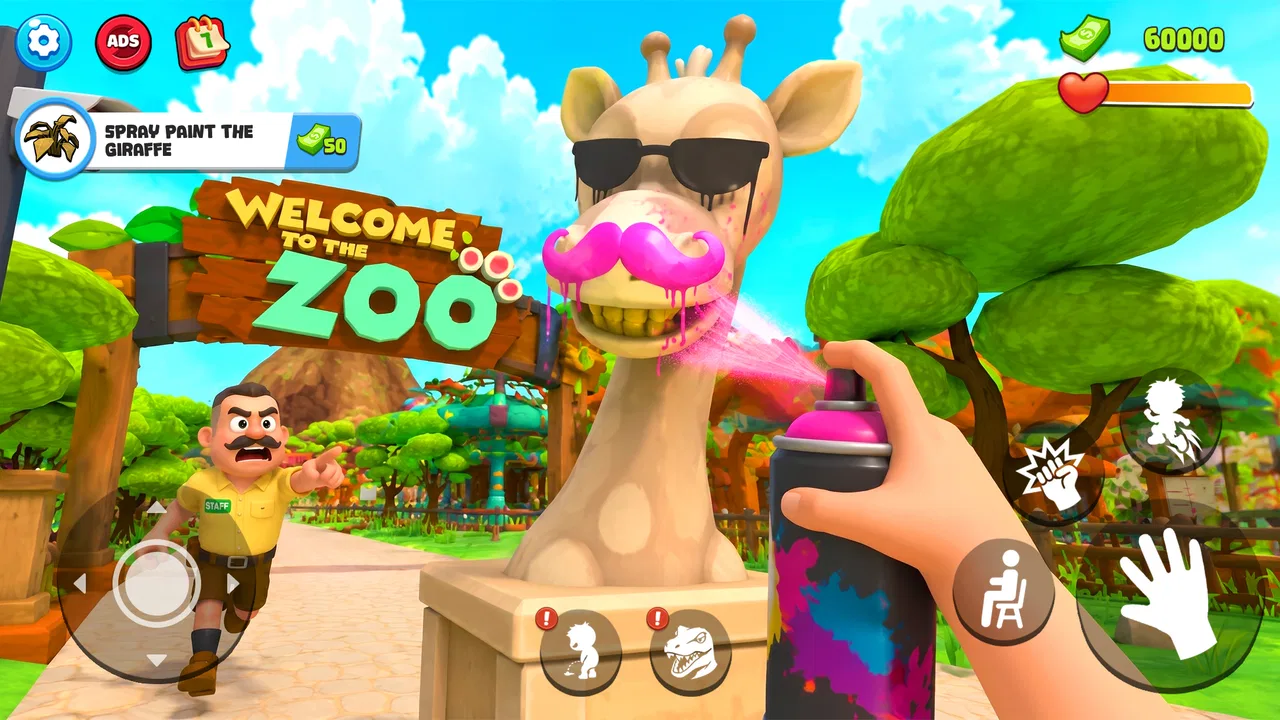
Zoo Prank: Crazy Animals immediately presents itself as a lighthearted simulation game built around sneaking through a zoo and setting up amusing tricks for its animal residents. I found the basic idea easy to understand within moments: move carefully, watch the surroundings, and look for the right opportunity to cause harmless chaos. It is not trying to be a serious management simulator or a demanding stealth adventure. Its appeal comes from playful timing, a silly setting, and the satisfaction of seeing a small plan turn into a funny reaction.
That simple premise gives the game a clear identity. Instead of asking me to run the zoo, breed animals, or manage staff, it puts me on the mischievous side of the fence. The result is a compact kind of entertainment that works well when I want something amusing without learning a large rule set. The store summary describes sneaking around the zoo and trolling animals with funny tricks, and that captures the tone more accurately than a grander genre label would.
As a free game from Unicorn Studio Official, it is easy to approach, especially for players who enjoy short simulation experiences with a cartoon-like sense of humor. The game is rated Teen, so I would still check whether its style suits younger players rather than assuming that a colorful animal setting automatically makes it suitable for everyone. The listing shows a 4.6 average from around 13 thousand ratings, and the game has passed five million installs, suggesting that its straightforward joke-driven format has found a sizeable audience.
You May Also Like

 Blood Strike: 2.5 Anniversary
Blood Strike’s Loadouts Turn Every Drop Into a Tactical Gamble
A close look at Blood Strike’s custom loadouts: how fast access to signature weapons reshapes its battle royale rhythm, rewards preparation, and narrows the gap between fights.

 Pandora - Music & Podcasts
Pandora’s Music Is Easy to Start, but Harder to Recover
Pandora’s strength is its low-effort path from a seed to a station. Its weak spot is how much confidence it asks you to place in connection, setup, and quiet recovery.

 8 Ball Pool
 Is Built on Rivalries, Rematches, and Routine
A close look at the rivalries, rematches, shared routines, and unanswered safety questions that turn a quick pool match into a persistent mobile community.

 Samsung Music
’s Quiet Strength Is Playing What You Already Own
Its reach comes less from spectacle than from dependable access to a personal library. That simplicity is both the app’s strongest retention engine and its ceiling.

 AccuWeather: Weather Radar
AccuWeather Review: A Quick, Clear Forecast for Everyday Decisions
For everyday plans, the best forecast is the one you can understand quickly. AccuWeather makes rain timing, radar, and local conditions easy to act on, with a few trade-offs.

 Hill Climb Racing
Why Hill Climb Racing Still Turns Crashes Into One More Run
A tiny car, a bumpy hill and one more upgrade: Hill Climb Racing keeps resurfacing because its simple chaos makes every near-miss feel personal.
More From Our News Desk



How the zoo turns a simple prank into a playable mood
I find the game’s appeal less about pulling off a grand scheme and more about settling into a mischievous rhythm: notice the space, choose a moment, and see whether the setup pays off. That makes each attempt feel like a tiny performance rather than a task to rush through. With that mood in mind, the next section looks at how the zoo’s layout helps the simple idea feel playable.
The first minutes: quick access, clear intent
My first impression was that the game understands the value of getting to the point. There is no need to absorb a complicated economy, a long character history, or a dense collection of menus before the central joke becomes clear. The zoo is the stage, the animals are the targets of the mischief, and the player’s job is to create a moment that feels surprising rather than merely complete a routine task.
That clarity is one of its strongest qualities. Many simulation games use their theme as decoration around a system of upgrades and resource management. Here, the setting and the action are much closer together. The zoo is not just a background; it explains why the player is moving carefully and why each encounter can be treated as a small performance. I could understand what the game wanted from me without needing to translate a complicated objective into something enjoyable.
The trade-off is that a focused premise can also expose repetition more quickly. If I am looking for a deep simulation with long-term planning, this is unlikely to satisfy me. Its pleasure depends on the charm of individual situations and the timing of the prank. Once that rhythm becomes familiar, the game has to rely on variety in its scenes and reactions to keep the experience feeling fresh.
I think it works best in short sessions. A realistic everyday use case would be playing for a few minutes while waiting for an appointment or taking a break from work. The game’s concept is immediately readable, so I do not need to prepare mentally for a long strategy session. I can enter, try a few mischievous ideas, and stop before the playful loop starts to feel overused.
A visual language built around mischief
The art direction does important work because the premise could otherwise feel too thin. A zoo naturally provides recognizable spaces, animal enclosures, paths, and visual obstacles, while the prank theme gives those familiar elements a comic purpose. The setting tells me where to look and also encourages me to treat the environment as part of the joke. A corner, barrier, or animal area can become meaningful because it changes how safely I can approach a situation.
What I appreciate is the contrast between an orderly public place and the player’s unruly behavior. Zoos are normally associated with observation and controlled movement. Turning that environment into a playground for sneaky tricks creates a small tension without making the game grim. I am not trying to escape a dangerous facility or solve a serious crime; I am trying to get close enough to produce an amusing disruption and then deal with the result.
This visual framing also helps the game communicate its mood without relying on lengthy explanations. A player can read the scene through the arrangement of paths and enclosures. The environment suggests where the risk might be, where a prank could be staged, and where the player should pause before moving. That makes the art direction functional rather than purely decorative.
Still, players who prefer realistic animal behavior or a detailed simulation of zoo life should adjust their expectations. The animals serve the game’s comic situations first. The setting is coherent because it supports the joke, not because it attempts to model every part of operating a real zoo. For me, that is the right choice for this concept, but it limits the game’s appeal for anyone seeking authenticity.
Why the setting matters more than the premise suggests
The zoo gives the game a useful sense of progression even when the underlying activity remains simple. Moving from one area to another can change the visual context and the way I approach a prank. A quiet path creates a different feeling from a crowded-looking enclosure, and a more open space can make a failed attempt feel more obvious. These differences help prevent the experience from becoming a sequence of identical screens.
One practical tip is to treat each area as a timing puzzle rather than rushing directly toward the nearest animal. I found the mood works better when I first read the space, identify a safe approach, and only then commit to the trick. That habit makes the game feel more like playful stealth and less like tapping through a checklist. It also gives the environment a role in the mechanics without requiring complex controls.
The same approach helps players who become frustrated by failed attempts. Instead of repeating an action immediately, I would change the route or wait for a better opening. The game’s humor is more effective when the player feels responsible for creating the moment. A rushed attempt can reduce the joke to trial and error, while a little observation makes the outcome feel earned.
Sound, pacing, and the shape of a successful joke
The sound design supports the game’s playful atmosphere by reinforcing the difference between quiet preparation and comic payoff. In a prank-focused game, sound does not need to create a huge cinematic world. It needs to tell me when the mood has shifted: when I am moving cautiously, when an action has landed, or when the situation has become more chaotic than planned.
I found that this relationship between sound and pacing matters because the game’s humor depends on anticipation. If every action arrived at the same speed and volume, the zoo would feel flat. The more effective rhythm is a short period of caution followed by a quick release. That pattern makes even a modest trick feel like an event, provided I have taken the time to approach it properly.
The pacing also keeps the game from becoming a conventional stealth title. A serious stealth game might ask me to memorize patrol routes, manage several resources, or recover from a failure through a long chain of consequences. Here, the tension is lighter and more immediate. I am watching for an opening because it makes the prank funnier, not because the whole campaign depends on perfect execution.
That distinction is important when deciding whether to install it. Players who want relaxing humor may enjoy the gentle suspense. Players who want intense stealth pressure may find the stakes too low. The game’s strongest mood appears when it remains mischievous, readable, and slightly unpredictable rather than becoming genuinely stressful.
Where the mechanics and presentation fit together
The central mechanics make sense because they match the visual and tonal direction. Sneaking encourages me to pay attention to the zoo’s layout, while the prank objective gives that movement a clear reward. The animals are not passive scenery; they are the reason I am studying the environment. This connection between movement, setting, and reaction is the game’s most coherent design decision.
A useful way to play is to separate the experience into three steps: observe, approach, and commit. First, I look at the available route and the likely point of interaction. Next, I move into position instead of treating the whole area as safe. Finally, I trigger the prank only when the setup feels right. This workflow is simple, but it makes the game more satisfying than rushing from one obvious prompt to the next.
Another non-obvious strength is that the game can work as a social screen experience. I can imagine showing a short attempt to a friend and letting them judge whether the approach was clever or unnecessarily reckless. The humor is visual and immediate enough to explain itself, so it does not require a long tutorial before another person understands what is happening. That makes it more suitable for casual sharing than a slower, menu-heavy simulation.
There is also a clear trade-off in the game’s free-to-play structure. The price is free, while optional purchases are listed at between 99 cents and $1.49 per item. That low entry barrier makes it easy to test the concept without committing money first. At the same time, anyone sensitive to in-app purchases should pay attention to how those options fit into the play session and decide in advance whether they want to spend at all. I would begin without buying anything and judge whether the basic prank loop already feels complete.
The current version is 1.1.8, and the minimum operating-system requirement is Android 7.1. That makes the game approachable on older compatible devices, although the experience will still depend on the phone’s general performance and screen responsiveness. I would not choose it for a device with severe lag or unreliable touch input, because timing and movement are central to the humor. A delayed action can make a carefully prepared prank feel unfair rather than funny.
Who will enjoy it, and who should pass
I would recommend this game to players who like short, mischievous simulations, cartoon animal settings, and objectives that are easy to understand but more entertaining when approached creatively. It is especially suitable for someone who wants a break from competitive games. There is no need to master a large combat system or study a complicated economy before enjoying the premise.
It may also suit fans of prank-based mobile games who value presentation as much as mechanics. The zoo setting gives the idea a stronger identity than a collection of unrelated trick scenes would have. The art direction, environment, and sound rhythm all point toward the same mood, which makes the game feel more intentional than its simple controls might suggest.
I would skip it if my priority were a detailed animal-care simulation, a realistic management game, or a demanding stealth challenge. It is also not the best choice for someone who dislikes repeated attempts around a small central idea. The game’s success depends on finding amusement in the setup and payoff, so players who need constant mechanical expansion may lose interest sooner.
Compared with a traditional zoo-management game, this experience is much less concerned with budgets, staff, habitats, and long-term planning. Compared with a conventional stealth game, it is lighter, shorter, and more focused on comic consequences than punishment. That middle position is its reason to exist. It offers a playful simulation mood without asking me to manage an entire institution or endure high-pressure infiltration.
Practical expectations before downloading
The game is free to start, but the presence of item purchases means I would review the purchase settings on the device before handing it to a child or letting someone else play. The Teen content rating is another reason to make that decision deliberately. A colorful presentation can make a game look universally appropriate, but the rating should guide the final choice for a family device.
I would also approach the download with the right session length in mind. This is not the kind of game I would install expecting a deep evening-long campaign. Its best use is as a compact diversion, especially when I want a clear objective and a humorous result without a large time investment. If the first few attempts make me smile, the focused design becomes an advantage; if the basic joke does not connect, additional play is unlikely to change my opinion completely.
One final tip is to judge the game by the quality of its moments rather than by the number of systems it offers. The satisfaction comes from arranging the approach, reading the setting, and seeing the prank land with the right comic timing. Looking for complex progression can make the game seem underdeveloped, while accepting its small-scale design makes its strengths easier to notice.
My atmosphere verdict
Zoo Prank: Crazy Animals succeeds because its presentation and mechanics speak the same language. The zoo is recognizable enough to guide movement, the visual style supports harmless mischief, and the sound and pacing give each attempt a small rise and release. I never felt that the setting was merely pasted onto unrelated tasks. The environment exists to make the prank possible, and the prank gives the environment its playful energy.
That coherence does not remove the game’s limitations. The central loop is narrow, the stakes are intentionally modest, and players seeking realistic simulation or serious stealth should look elsewhere. Optional purchases also mean that I would approach the free format with reasonable awareness rather than assuming every part of the experience is equally open.
For the right player, however, the focused design is exactly what makes it appealing. I can pick it up during a short break, understand the objective immediately, experiment with a route, and enjoy the result without carrying a complicated system in my head. Unicorn Studio Official has built a game around a small but clear idea, and the art direction, setting, sound, and pacing give that idea enough personality to work.
My recommendation is simple: try it if you want a free, comic zoo simulation built around sneaky timing and playful reactions. I would not present it as a replacement for a full management or stealth game, but as a lighter alternative with its own mood. When I treat each attempt as a tiny piece of mischievous theater rather than a serious challenge, the game is at its most enjoyable.
FAQs for Zoo Prank: Crazy Animals
01What is Zoo Prank: Crazy Animals about?
Zoo Prank: Crazy Animals is a casual entertainment game centered on playful interactions with zoo animals. Instead of managing a realistic zoo, you complete amusing scenarios by tapping, dragging, and experimenting with objects around different animal enclosures. The main appeal is its lighthearted humor, simple controls, and short challenges, making it suitable for quick sessions when you want something funny and easy to play.
02How do you play Zoo Prank: Crazy Animals?
Gameplay is based on observing each scene and discovering how to trigger the intended prank or reaction. You generally interact with animals, visitors, and environmental objects by tapping or swiping the screen. Some solutions are obvious, while others require trying different items in the correct order. The controls are uncomplicated, but careful observation is important because the game often hides the solution in small visual details.
03Is Zoo Prank: Crazy Animals free to download and play?
The game is generally available as a free download, allowing players to try its core levels without paying upfront. However, free mobile games may include advertising, optional purchases, or other monetization features depending on the version and platform. Before downloading, it is worth checking the store listing for current information about ads, in-app purchases, supported devices, and any age or content notices.
04Is Zoo Prank: Crazy Animals suitable for children?
Zoo Prank: Crazy Animals uses cartoon-style animals and humorous situations rather than realistic violence, so it may appeal to children and casual players. Nevertheless, parents should review the age rating and store description because advertising, optional purchases, or prank-based humor may not suit every child. Younger players may also need supervision if the game displays external ads or purchase prompts.
05Does Zoo Prank: Crazy Animals require an internet connection?
The basic levels may be playable without a constant internet connection, which is useful for short sessions while traveling or when mobile data is unavailable. Still, the exact offline functionality can vary between updates and device versions. An internet connection may be needed for advertisements, restoring purchases, downloading additional content, or accessing certain features, so it is best to test the game after installation.
Pros
- Funny animal reactions make each prank feel entertaining.
- Simple controls are easy for younger players to understand.
- Short levels work well for quick gaming sessions.
- Bright visuals give the game a cheerful
- playful style.
- Offline play is convenient when no internet connection is available.
Cons
- Repeated prank mechanics may become predictable after extended play.
- Frequent ads can interrupt the flow between levels.
- Some challenges rely more on timing than meaningful strategy.
- Progression may feel limited for experienced puzzle-game players.
- Sound effects can become repetitive during longer sessions.

Zoo Prank: Crazy Animals
Gallery